
I have been thinking for a while now about ways to retain water for longer in its passage through the quinta. Not just for irrigation purposes, but to increase the range of environments we have for growing and to support a greater diversity of wildlife. The extent to which we can emulate strategies like Sepp Holzer’s at the Krameterhof and Tamera is constrained by the vastly smaller amount of land we have to work with, not to mention the topography and difficulty of access, but even on a much smaller scale, the principles ought to be similar.

The quinta has slate-built concrete-lined tanks on each main terrace, designed to collect water from the stream and its springs, which is then released through sluices into irrigation channels along the back of each terrace to flood-irrigate crops grown on the terrace. Slate-lined channels underground beneath the terraces take the water from terrace to terrace. At the moment, the tanks are full of years of accumulated sludge, the irrigation channels are overgrown and the transport channels don’t function in quite the way they were designed to.
But even were we to restore this system to its original working order, it’s a predominantly anthropocentric system: designed for a specific agricultural purpose and not particularly user-friendly for wildlife. The tank sides, for instance, are far too precipitous for frogs to get in and out, and the very containment of the water limits its use to a particular form of irrigation of a particular form of cultivation. It doesn’t work for raised beds, though it would irrigate fruit trees well.
One idea has been to create a series of ponds for the water to flow through from terrace to terrace rather than using the underground channels. Constructing unlined ponds using Sepp Holzer’s techniques will also allow the development of wetlands in which to grow plants that thrive in this environment and encourage more amphibious wildlife which will hopefully enjoy feasting on our plentiful supply of slugs and snails.
First I wanted to experiment on a small scale with the construction technique.
Underneath the bottom terrace is a poço – a slate-lined underground dome with a collection tank below it, designed to collect water filtering through the ground above it. In order to keep the ground wet enough to supply my neighbours’ drinking water requirements, this area had become a stagnating marsh, breeding mosquitoes and bad smells, not to mention prodigious amounts of vegetation which considerably slowed the rate of water filtration. Turning this area into a shallow pond fed with plentiful clean water seemed a good project both to deal with my neighbours’ water supply issues and to begin my pond-building experiments.
I began digging with Simeon‘s help back in August. Together we created the first of two ponds, with the outfall of the first to feed the second.

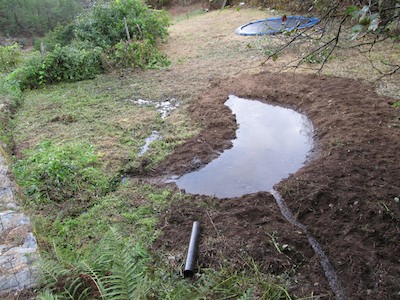
Upper pond dug and filling with water. Some of the fine sludge from the bottom terrace tank was put into this pond and, along with the clay-rich soil, was mixed and trod in imitation of pigs creating a wallow so that a natural seal is formed as progressively finer particles settle out and line the pond.
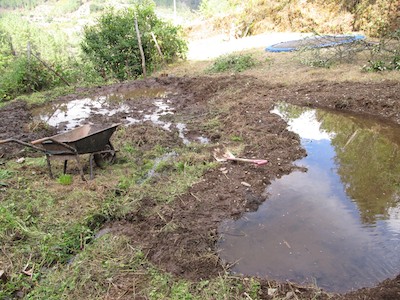

The digging of the second, lower pond. This pond is directly over the neighbours’ pouço and is necessarily very shallow.


The ponds after a month. Water levels maintain themselves very well with only an occasional adjustment required to compensate for sudden changes in flows upstream. The water is kept moving to prevent stagnation and the pond feeding the poço is full of sweet clear water. I would like to make the top pond larger and deeper though, and plan to do this sometime before Spring. Frogs have already been spotted swimming.

Duckweed (Lemna spp) starting to grow.
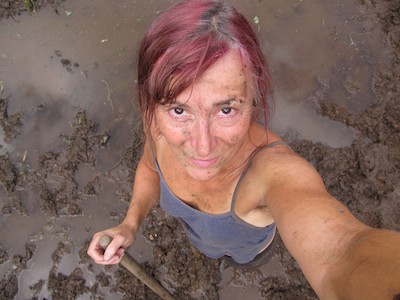
The pond digger
michelle October 31, 2011
you look gorgeous!!
And great work with the ponds.Looking lovely and clean though a fair amount of work I imagine.
Erik November 6, 2015
Hello,
How exactly do you create the liner? You write:
“Some of the fine sludge from the bottom terrace tank was put into this pond and, along with the clay-rich soil, was mixed and trod”
Do you repeat these actions several times? I mean, when you mix clay-rich soil and sludge and later trod it – do you mix it again? How do you mix it? By hand or with machines?
Thanks for your reply
Erik, Germany.
Quinta do Vale November 6, 2015 — Post author
Hi Erik. This is basically the Sepp Holzer method of sealing a pond based on his observations of how pigs make a wallow. This video tells you … https://www.youtube.com/watch?v=3vHXa3y8B7M … the sound quality is awful but the English translation subtitles fill in most of the gaps.
Except I did it with my feet because I can’t get any machinery onto most of this land and because the ponds here are small. And I didn’t do it too much to make a complete seal because the water needs to percolate through the terrace to the poço beneath it to keep the neighbouring quinta’s water supply running.
Erik November 7, 2015
Thank you so much for answering so fast and thanks for the video. Now it’s a bit clearer. I understand him well.
When you create a pond in the futue – maybe you could record that on video. It would be helpful for generations of permaculture farmers to come ;-)
1) When you work on your pond mixing and treading the soil as Holzer explained – do you only do that in the middle of the pond where the pond has got its DEEPEST SPOT or do you also mix and tread the soil at the EDGES?
2) When you do it with your feet – do you mix the clay and soil beforehand in a bucket or do you mix it in the pond with your feed?
3) When you want your ponds to perculate – is there a permanent influx of water in order to keep the water level constant? (I suppose perculating water reduces the water level of your pond)
Thanks again and all the best
Erik.
Quinta do Vale November 7, 2015 — Post author
I tread the whole pond area – water will percolate anywhere it’s in contact with soil, not just the deepest part of the pond. The clay is already in the soil that I’ve dug the ponds out of. The fine sludge I add from the water tanks is just shovelled into the pond and the whole lot stomped and mixed about while the water is still quite shallow. This puts the finer particles into suspension and spreads them out more evenly. Yes, there’s permanent water flow running through the ponds. The point in creating unlined ponds was to slow the passage of water through the land and increase the hydration level of the surrounding soil. They work well in that regard, though it does take some time to get them properly established which is only to be expected. Small ponds are sensitive to small perturbations.
Videoing the pond creation process is not something I’m likely to do I’m afraid unless I have someone else on hand to do it for me – sensitive electronic equipment and large quantities of mud and water don’t go well together … There’s no real technique to it as such – you just stomp about in the water. Some neighbours of mine made a pond that wouldn’t seal so they abandoned the project. There was a bit of water left in the bottom and their dog spent the summer in there chasing frogs. By the time the winter rains came, the pond held water. Perhaps the quickest and most effective pond-sealing regime would be to wait for some nice hot summer days, let some water into the pond, and invite all the neighbourhood children round to play in it all day for a few days. You could then add some ducks – their manure will help seal a pond too.
Here’s an account of someone who made a larger pond with pigs – http://permies.com/t/38201/ponds/Progress-Gleying-Pond-Pigs
And here are some notes about various other techniques – http://www.waldeneffect.org/blog/How_to_gley_a_pond/